
Together with the Optolab team, he developed a coded aperture mask that enables the reconstruction of ultra-high-speed videos in high quality for capturing dynamic events.
Dr. Felipe Guzmán, postdoctoral researcher, designed a new scalable coded aperture mask—a matrix that regulates how light reaches the sensor—for high-speed imaging systems. This technology can be applied to advanced research on fast phenomena such as explosions, chemical reactions, and astronomical observations.
This study is one of Guzmán’s most recent works in the area of compressive sensing and was developed entirely by members of the Optoelectronics Laboratory at Pontificia Universidad Católica de Valparaíso.
The article, “Scalable Coding for High-Resolution, High-Compression Ratio Snapshot Compressive Video,” was published in June 2025 in the journal IEEE Transactions on Image Processing.
Scalable solutions for reducing costs
The proposal emerges as a more accessible and versatile alternative to current high-speed cameras, which require large amounts of storage and bandwidth to record events that occur in milliseconds.
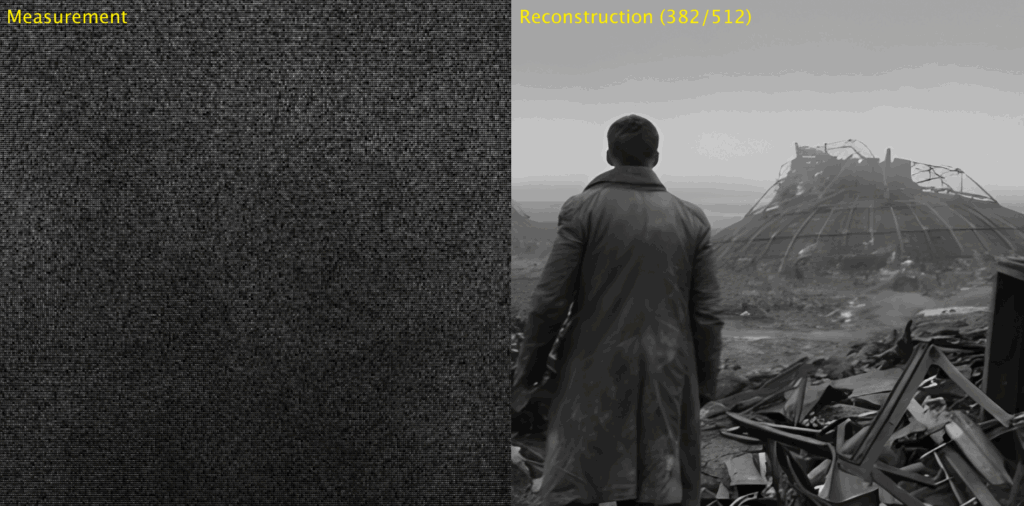
To address this, Felipe designed a coded aperture that enables the compression of high-resolution videos into a single image, allowing efficient reconstruction of the information through universal algorithms.
“High-speed cameras are large systems that can fill up memory within seconds. That makes them expensive and inefficient. With coded apertures, we encode the information during acquisition, so we don’t need a powerful computer for decoding, since the optics have already done much of the work,” explains Dr. Guzmán.
In addition to reducing costs, the system is both scalable and flexible: users can adjust the parameters of the technique to prioritize either higher resolution or a greater number of frames, without sacrificing performance. Felipe adds:
“In the paper, we analyze how much spatial resolution we lose and how much temporal resolution we gain, and we provide design parameters for the mask. So, if someone wants better quality, they can trade off for higher compression”.
The method was validated experimentally, successfully compressing 512 frames into a single image, which is enough to fully capture an ultra-fast event.
As for next steps, Felipe notes that the upcoming challenge is to enhance the quality of reconstructed videos and incorporate color information into the mask design.
We congratulate Dr. Felipe Guzmán and the Optolab team for designing cost-effective and universal solutions that promote and democratize the widespread use of ultra-high-speed cameras in science.