
The research team will develop new adaptive optics techniques powered by artificial intelligence to enable next-generation satellite and free-space laser communications with higher bandwidth and enhanced security.
QOMMTRUE, ATE250061 – Smart Adaptive Optics for Quantum and Classical Communications through the Atmosphere is one of only three initiatives selected nationwide by Agencia Nacional de Investigación y Desarrollo (ANID) under the category “Artificial Intelligence and Quantum Computing.” The 2025 Thematic Research Team Projects Program awarded the proposal USD $750K for its execution over the next three years.
This is the second ANID Thematic Anillo Project led by Dr. Esteban Vera, professor at the PUCV Escuela de Ingeniería Eléctrica and head of the Optoelectronics Laboratory. QOMMTRUE builds upon the advances achieved through SEETRUE (ATE220022), a previous ANID-funded project that consolidated a strong interdisciplinary group including Dr. Vera (EIE-PUCV), Dr. Darío Pérez from the PUCV Institute of Physics (IFIS), and Dr. Marcos Díaz from the Department of Electrical Engineering at the University of Chile (DIE).
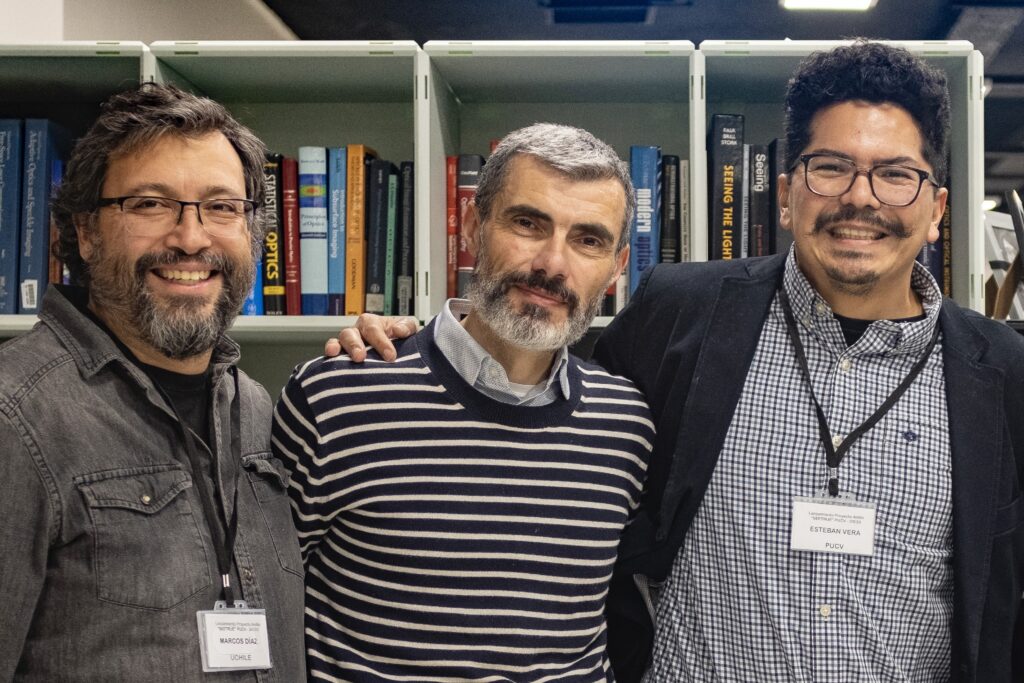
From left to right: Marcos Díaz (UChile), Darío Pérez (IFIS PUCV) y Esteban Vera (EIE PUCV).
During SEETRUE, the team installed an Optical Ground Station (OGS) with a 50 cm telescope on the PUCV Curauma Campus, an infrastructure that will continue to grow with the upcoming arrival of a new 1-meter telescope, funded through the 2024 Fondequip Mayor award (EQY24003). Together, these systems form the SPOXC Space Observatory, which will play a central role in the development and validation of the new project.
Communications of the Future
The accelerated increase of satellites in low-Earth orbit has opened new possibilities for ultra-high-speed and quantum satellite communications using laser light.
In this context, QOMMTRUE focuses on designing innovative adaptive optics (AO) systems based on artificial intelligence to correct the distortions experienced by light as it travels through the atmosphere. These developments aim to support the optimal operation of secure, high-speed free-space optical communication links.
Threats and new horizons enabled by quantum computing
Alongside artificial intelligence, quantum computing is one of the most transformative technological developments of the coming decades. Its ability to solve extremely complex computational problems in seconds is redefining the limits of modern computing.
However, this breakthrough also poses a significant risk. With current methods, the security of digital communication is increasingly vulnerable, as traditional encryption keys—long used to protect information across networks—are on the verge of becoming obsolete. In this scenario, quantum keys become essential: they are inherently more secure and can instantly reveal any attempt at interception.
“Quantum computing will be capable of solving combinatorial problems at astonishing speeds, rendering traditional encryption obsolete. There is now an urgent need for technologies that enable the generation, transmission, and reception of quantum keys to ensure inviolable communication,” explains Dr. Vera.
He adds that, although quantum key distribution (QKD) is already possible through optical fiber, the scientific community is now focused on achieving satellite-based quantum encryption, which would enable global-scale secure communication.
Adaptive optics technologies play a crucial role in this shift, preparing and stabilizing the optical channel to allow light carrying quantum states to propagate through the atmosphere. To validate these developments, QOMMTRUE aims to establish a 55-kilometer fixed optical link between the PUCV Optical Ground Station and several systems to be installed at Cerro El Roble.
This free-space link will function as an open platform for national and international research groups to test classical and quantum laser communication technologies.
Regarding this effort, Dr. Vera notes that the link will reproduce conditions similar to those encountered in future satellite systems, allowing real-world evaluation of the developed techniques under severe turbulence conditions that are difficult to emulate in laboratory simulations.
“This project validates the strength and quality of the research team we have built at PUCV. It consolidates us as national leaders in this field and allows us to continue training highly skilled students and researchers, while strengthening collaborations with universities and space agencies around the world”, emphasizes Dr. Vera.
Impact and Strategic Vision
The technologies developed through QOMMTRUE will enable the creation of more compact, cost-effective, and scalable optical ground stations, which are critical for future satellite communication networks and for the secure transmission of quantum information.
The project is supported by key international partners, including the Laboratoire d’Astrophysique de Marseille, the French aerospace agency ONERA, and the University of Tokyo, all of whom will contribute to different stages of technological design and validation.
With QOMMTRUE, PUCV positions itself as a strategic actor in the global ecosystem of quantum and optical technologies, advancing toward solutions that will transform the way we communicate—on Earth and beyond—forming part of the technological backbone required for future space exploration.