
A researcher from Optolab PUCV, in collaboration with the University of Tokyo, has published a technique based on artificial intelligence capable of reconstructing video through scattering media without invasive intervention.
Dr. Felipe Guzmán, postdoctoral researcher at Optolab, presents in his new article a cutting-edge method for forming images through objects or media that distort light — such as the atmosphere or biological tissue — using deep learning techniques.
In 2023, Dr. Guzmán completed a doctoral research stay at the Information Science Laboratory at the University of Tokyo, led by Dr. Ryoichi Horisaki. There, he became involved in the study of imaging through scattering media, contributing his expertise in compressive sensing and expanding the research beyond static imaging toward video reconstruction.
The article, published in April 2025, is titled “Snapshot video through dynamic scattering medium based on deep learning” and represents the second collaboration between the two researchers. The work addresses one of the major challenges in contemporary optics: how to see through irregular and dynamic media that scatter light.
In addition, the researchers imposed an extra constraint: the method had to be non-invasive. “For example, in adaptive optics we fire a laser or use a guide star as a reference. Here, we assume no reference exists. This makes the method highly versatile; if we want to see through skin, we do not need to make an incision”, explains Dr. Guzmán.
Although previous techniques exist for imaging through scattering media, they face limitations in fluctuating or unstable environments, as they depend on solutions capable of maintaining spatial and temporal consistency. In contrast, the method proposed by Guzmán and Horisaki enables the reconstruction of an entire video from a single captured image, without requiring large volumes of data.
“Traditional methods are iterative and must progressively refine the solution”, notes the researcher. “This new deep-learning-based procedure provides an instantaneous solution, you input the image, and it outputs the video.”
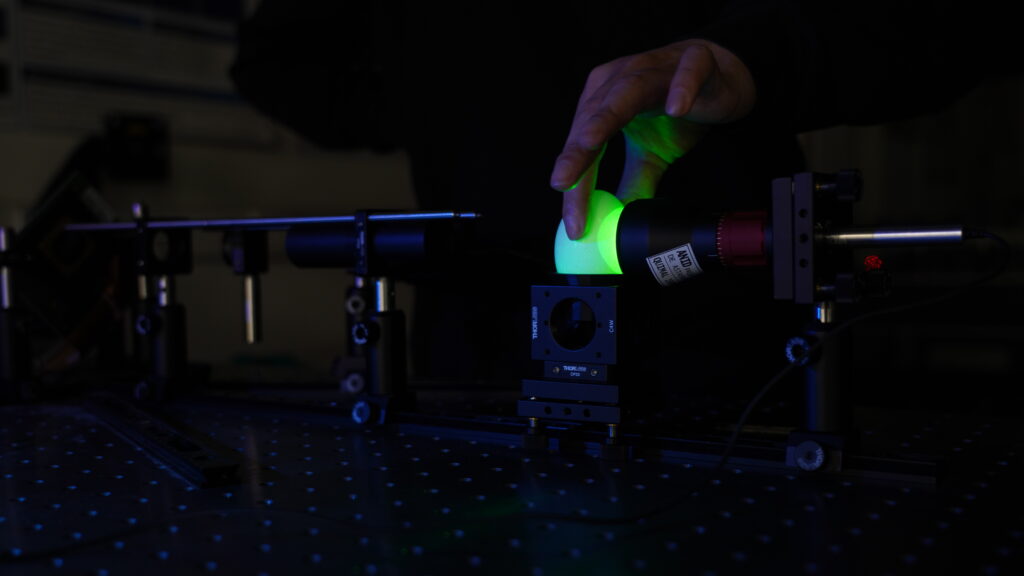
The method was experimentally validated on the optical tables of the Optoelectronics Laboratory at PUCV, using a diffuser — a plate containing scattering particles — as the scattering medium.
“The experimental work was the biggest challenge”, says Dr. Guzmán. “When you can see the object, you can focus it. But if you cannot see it, how do you focus? It brings a series of experimental challenges that were new to me”.
As next steps, the team plans to test the method with other diffusive materials, such as chicken breast or eggshells. “Since we do not characterize the scattering medium and the method is non-invasive, we are not concerned with what lies in between. It can be anything, as long as it is relatively translucent”, he adds.
The researchers are currently working on an extension of the study, which will be presented at the international SI-Thru conference in Yokohama, Japan. This further strengthens the collaborative ties between the University of Tokyo and Optolab PUCV, opening new opportunities for students to engage in high-level research projects.