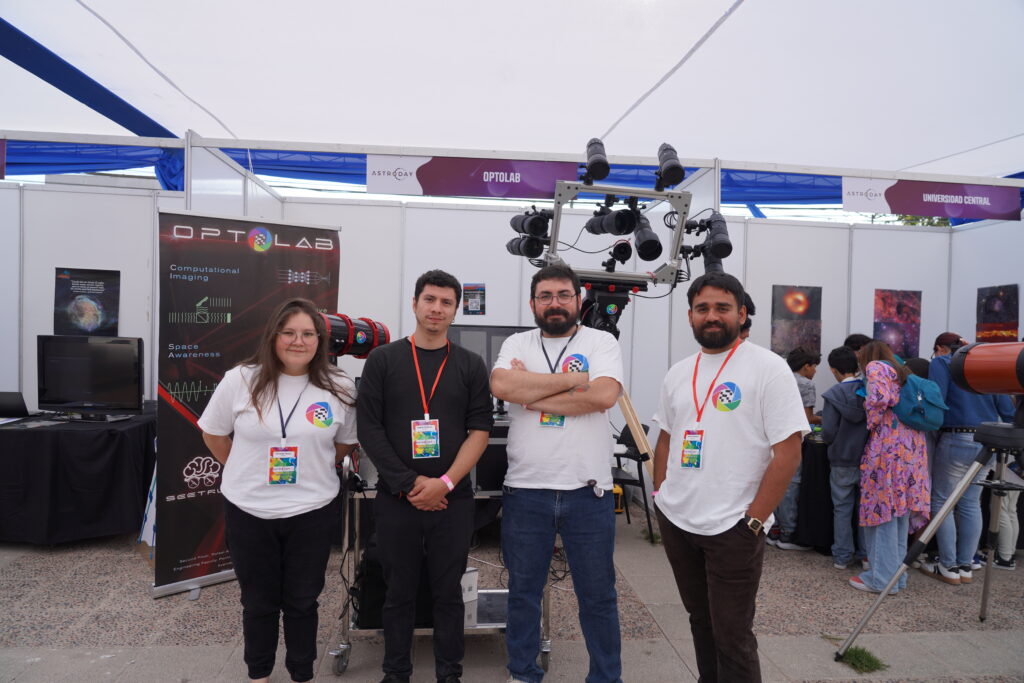
Research carried out by members of the Optoelectronics Laboratory (Optolab) was published in one of the most recognized journals in the aerospace field, presenting the advances achieved through the Fondecyt Regular project 1221883: COCTELS.
“ARACHNID: A Neuromorphic Multi-Camera System for Space Surveillance” is the title of the work led by researcher Sebastián Valdivia, in collaboration with the team composed of Vicente Westerhout and professors Esteban Vera and Daniel Yunge. The article was published in the prestigious scientific journal IEEE Transactions on Aerospace and Electronic Systems, presenting the construction and experimental validation of an architecture designed to observe the night sky in real time using neuromorphic vision technologies.
The publication represents a milestone for Chilean research, as it positions the team as the first from the country to publish in IEEE Transactions on Aerospace and Electronic Systems on Space Situational Awareness (SSA) and neuromorphic systems, including event-based cameras and spiking neural networks.
Space surveillance is an increasingly relevant area of research due to the sustained growth of satellites, artificial objects, and debris in orbit. This growth poses new challenges for the safety of space missions, as it increases the risk of collisions and makes the tracking of objects in the orbital environment more complex.
In this context, SSA systems are essential for detecting, monitoring, and predicting the behavior of these objects, making it possible to anticipate potential threats and contribute to safer and more sustainable space operations.
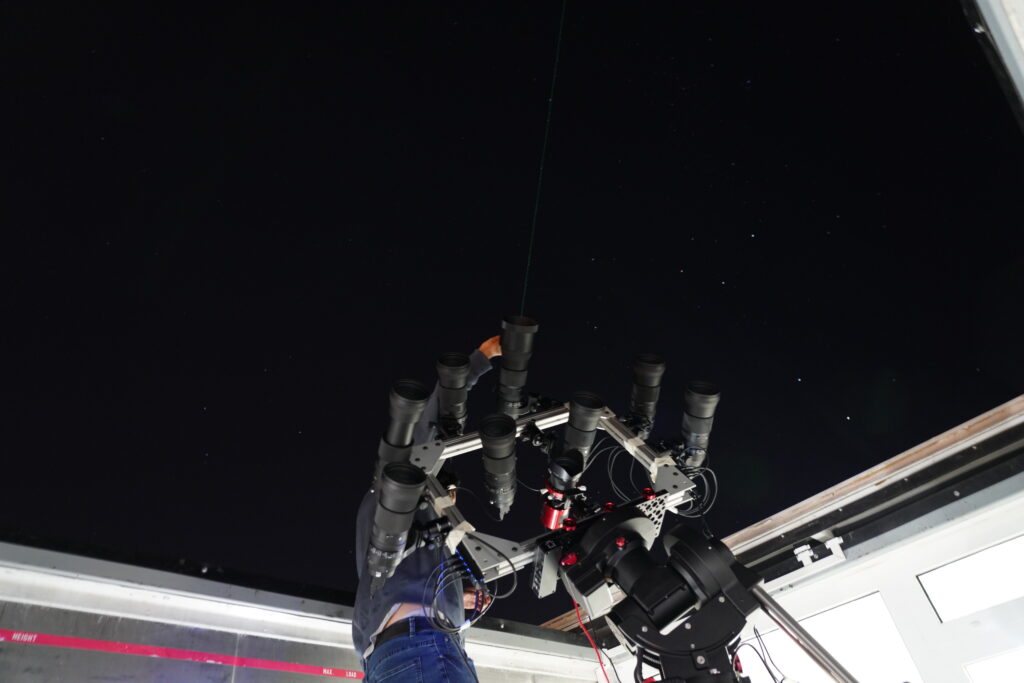
In particular, the publication presents the construction and validation of ARACHNID, an array of eight event-based neuromorphic cameras integrated with spiking neural networks for the detection and tracking of objects in the sky. The system enabled progress in key aspects for this type of application, such as scalability, low latency, and energy efficiency.
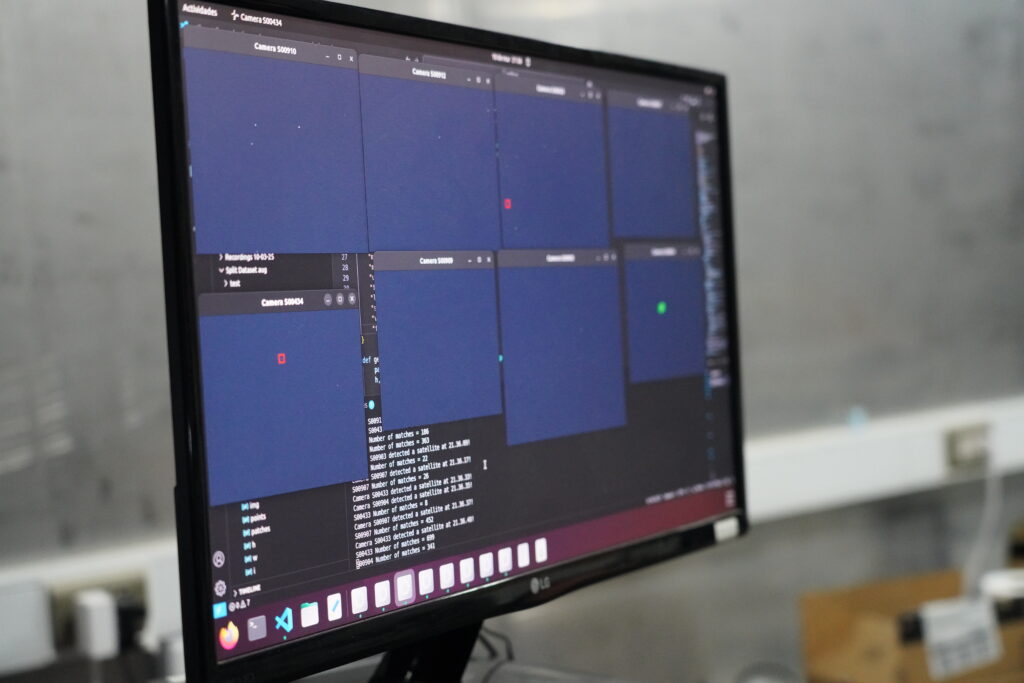
The lead author emphasized that “we did not stay only at the level of a theoretical idea, but managed to build and validate a physical system that operates in real time with eight cameras working together. This sends a very valuable message: neuromorphic computing can move beyond the laboratory and become a concrete solution for space surveillance”, said Sebastián Valdivia, who holds a Master’s degree in Engineering with a specialization in Electrical Engineering.
Although the system was designed for space surveillance applications, during its testing period it also showed potential for detecting other fast-moving objects, such as insects, drones, aircraft, and even meteors. This opens the door to possible future applications beyond the space domain.
Along with the validation of the ARACHNID system, the publication also presents the Event-based Vision Artificial Satellites (EVAS) dataset, which is openly available. This dataset involved nearly two years of observations, recordings, and labeling of real data obtained with event-based cameras, representing a significant contribution to the scientific community interested in neuromorphic vision and space surveillance.
“We wanted to include it in the publication because it not only supports the results of the ARACHNID system, but also provides a public resource that can be useful for other researchers to review, compare, and continue developing this type of technology”, Sebastián added.
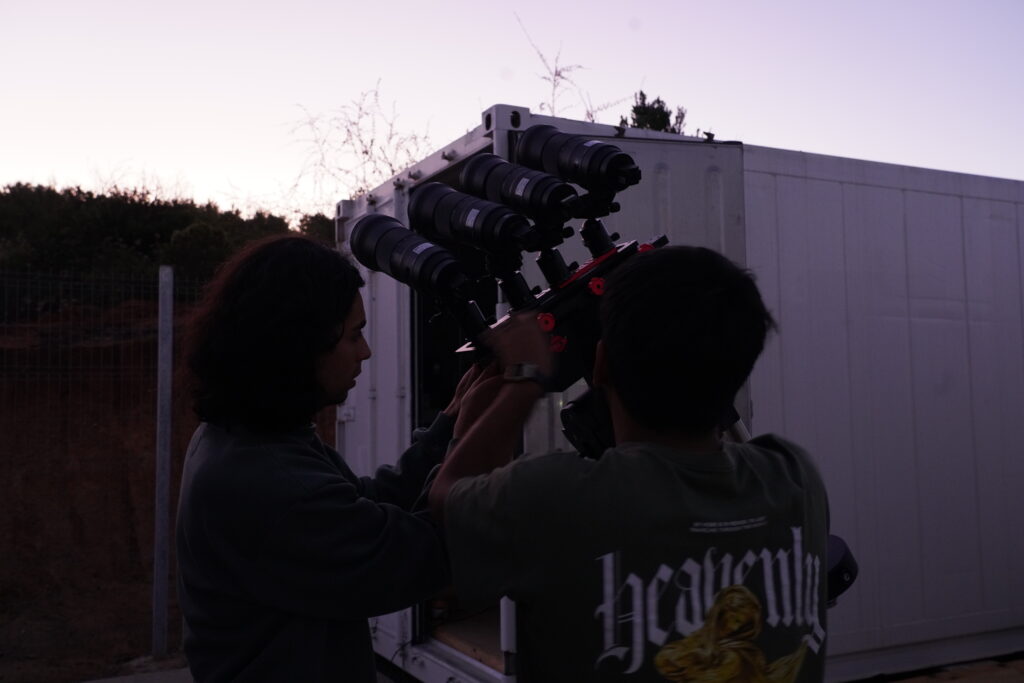
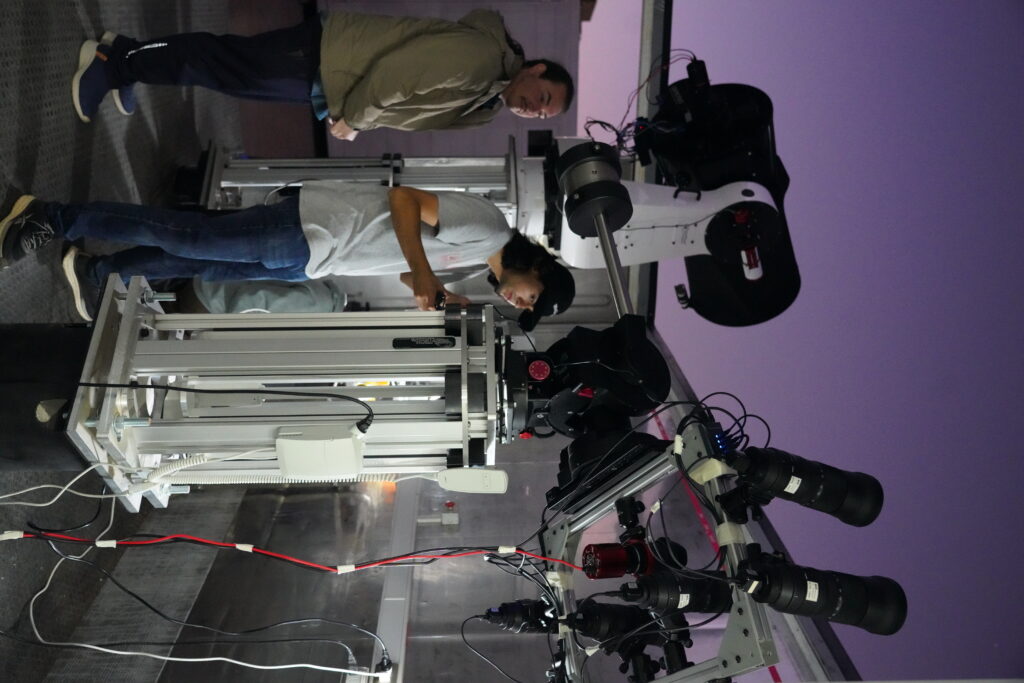
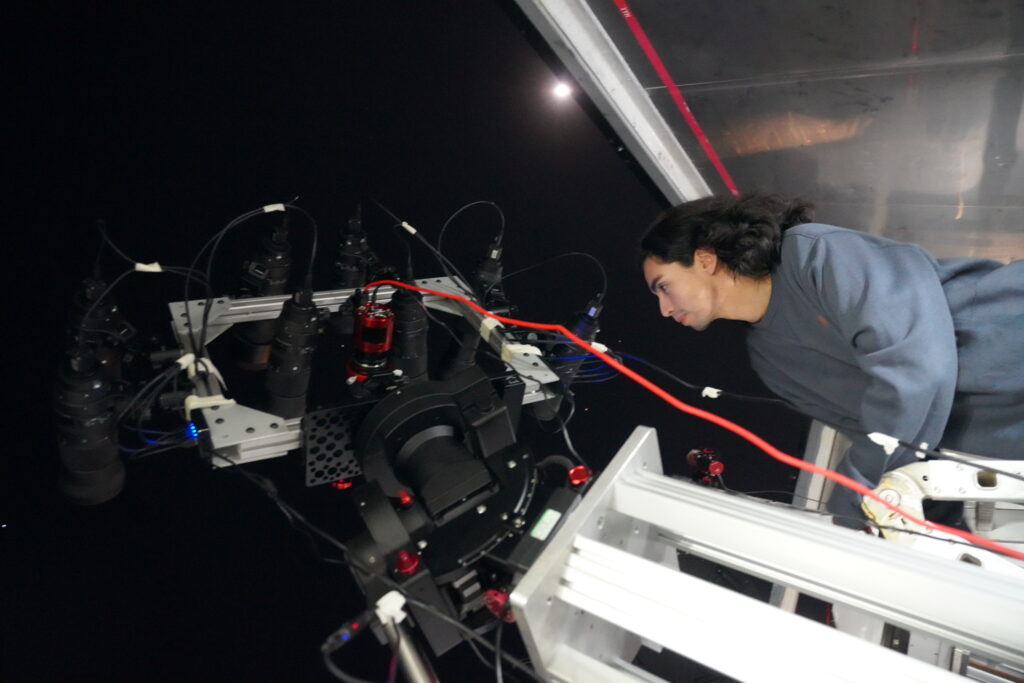
The research was a collective effort. From the assembly of the system to the observation sessions, data collection, and labeling process, several members of the laboratory team took part in the work. For Valdivia, the article’s publication in this journal confirms the scope of the proposal: “the fact that it was accepted in one of the most recognized journals in its field worldwide demonstrates that the proposal has both scientific and practical value,” the author highlighted.
The impact of the work is not limited to the publication itself. According to the researcher, this result also reinforces the contribution that can be made from Chile in highly specialized disciplines, “I also see it as a sign that Chile can contribute to frontier research in highly specialized areas, such as neuromorphic vision and space surveillance.”
In this way, ARACHNID not only validates a technology developed at Optolab, but also positions Chile and the Valparaíso Region within an emerging line of research for space surveillance, with its own infrastructure and the potential to contribute to global challenges related to safety and sustainability in orbit.