
Students delved into laser guide star technology in the context of the arrival of new equipment that will be key for the laboratory’s future research.
A delegation of students from the Laboratorio de Optoelectrónica PUCV participated in the fifteenth Laser Technology and Systems for Adaptive Optics (L4AO-15). The event, held at the University of La Serena, focused on laser guide star (LGS) technology—an essential element for astronomical observation using adaptive optics (AO) techniques.
The workshop brought together leading international specialists and experts in the field to present the latest findings on a new generation of lasers that are more efficient, safer, and more powerful, aimed at implementation in upcoming extremely large telescope (ELT) projects.
In this context, Ronald Holzlöhner, Laser Engineer at ESO, explained that the use of artificial stars is crucial for the optimal performance of adaptive optics systems. “You need an artificial light source in the sky for AO systems to operate successfully. We project a laser along the telescope’s line of sight to create a bright spot that is used as a reference signal to correct atmospheric turbulence,” he noted.
The world’s largest telescopes require increasingly stable, rigid, and high-intensity laser structures. “The specific challenge is that we need more lasers and higher-power lasers. For this, we distribute several laser projectors around the telescope, and now in the E-ELT we will have six and possibly even eight,” Holzlöhner added.
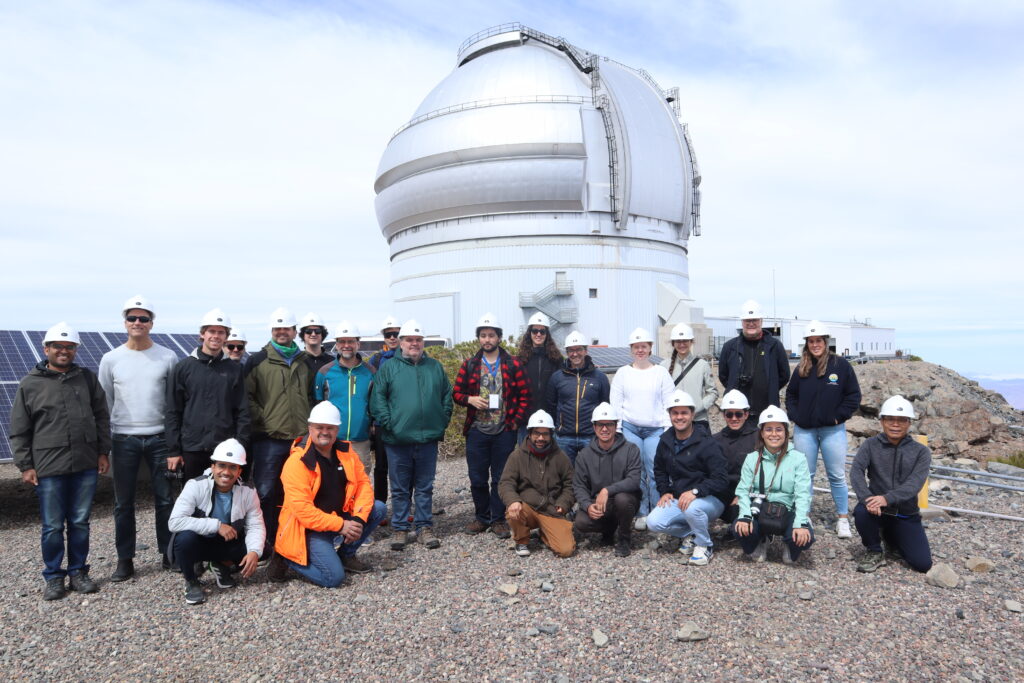
The workshop—held for the first time in Latin America—concluded with a technical visit to the AURA facilities, where attendees entered the Gemini South and SOAR telescopes operated by NOIRLab.
Additionally, at the academic event, PhD candidate Vicente Westerhout presented the results of a research project carried out in collaboration with the Australian National University. In his talk Exploring tip-tilt retrieval using an event-based sensor, he presented advancements in tip-tilt measurement for LGS using low-power, high-speed event-based cameras.
Technological Milestone: Gemini South’s Donation to PUCV
With the goal of expanding the university’s research capabilities, the Vicerrectoría de Investigación, Creación e Innovación PUCV is coordinating the donation process of an astronomical laser from Gemini South. This instrument will be installed at the PUCV Space Observatory and will enable students from the School of Electrical Engineering and the Institute of Physics to study adaptive optics at a more advanced level.
Furthermore, Felipe Pedreros, Head of the Laser and Photonics Group at ESO, highlighted the growing contribution of Chilean scientists in this area. “In the last ten years, there has been remarkable progress in radio astronomy, optical systems, sensing, and adaptive optics. I believe there is a great opportunity for international contribution because there are many highly trained people; we are moving in the right direction,” he emphasized.
The 2025 edition of L4AO was a valuable space for collaboration and the exchange of ideas among leading international experts in laser technology. The workshop served as a prelude to the AO4ELT conference, where scientific discussions continued for a full week in Viña del Mar.